
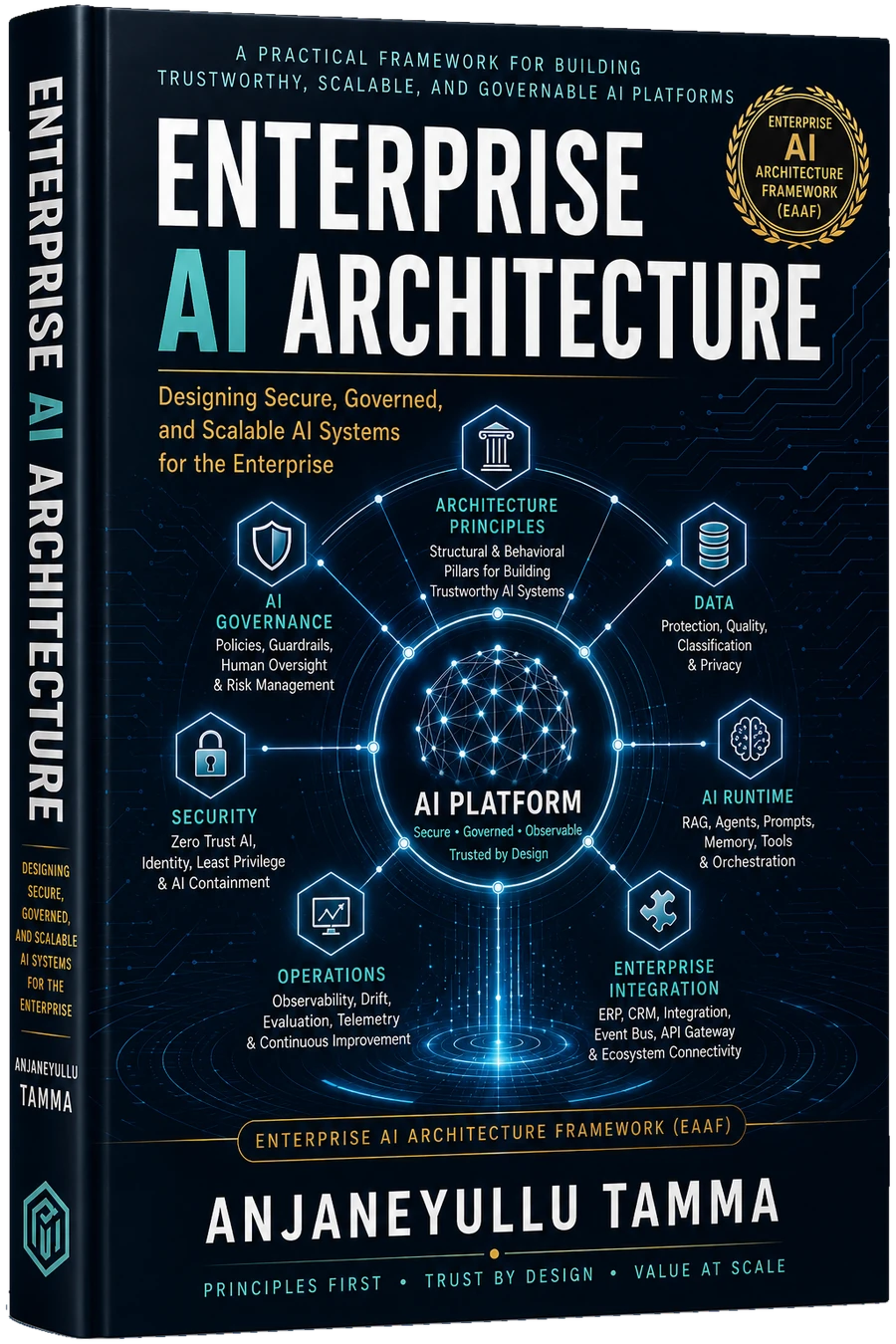
Enterprise AI Architecture — book cover, by Anjaneyullu Tamma
Coming early 2027 · In progress

Enterprise AI Architecture

A practical framework for building trustworthy, scalable, and governable AI platforms — the field guide I wished existed while doing this work in production.

I’m writing the book on how to design secure, governed, and scalable AI systems for the enterprise: the architecture principles, the runtime, the governance, and the hard-won patterns that separate an AI demo from AI you can put in front of a board, an auditor, and a customer.

What it’s about

From AI demo to AI you can defend.

Most organizations can stand up an impressive AI prototype. Far fewer can put one into production and defend it — to their board, their auditors, and their customers — when something goes wrong. The gap isn’t the model. It’s the architecture around it: how facts are retrieved, how actions are governed, how identity and data are isolated, and how every decision is made observable and accountable.

This book is a practical, vendor-neutral framework for closing that gap — drawn from building multi-tenant, agentic, retrieval-grounded platforms in a regulated industry. It’s written for the architects, engineering leaders, and executives who have to make AI work, safely and at scale.

The framework

Built on the Enterprise AI Architecture Framework (EAAF).

At the center sits the AI Platform — secure, governed, observable, and trusted by design. The book works through it across seven parts:

Principles first · Trust by design · Value at scale.

Want to go deeper? The public Enterprise AI Architecture Framework (EAAF) page gives a free preview of the model, and the Insights develop many of the book’s ideas chapter by chapter.

Read now · free

Two chapters to read today.

A taste of the book while the rest is written — the opening argument, and a hands-on chapter from the governance part. No sign-up required.

Inside the book

The full table of contents.

Seven parts, thirty-two chapters, a conclusion and a reference appendix — from first principles to a complete, buildable enterprise AI platform. A work in progress, arriving early 2027.

Front matter
  • Foreword Why trustworthy AI is an architecture problem.
  • Introduction Why most AI projects fail after the demo · AI is becoming enterprise infrastructure · Why existing cloud architecture patterns are insufficient · The AI Architecture Framework
Part I

Architecture Principles

  • 1 · Why Enterprise AI Needs Architecture Free The shift from applications to intelligent systems · AI as a platform capability · Enterprise vs consumer AI · Common failure patterns Read this chapter →
  • 2 · Structural Pillars AI platform layers · Reference architecture · Separation of concerns · Shared services · Multi-tenancy · Scalability · Composability
  • 3 · Behavioral Pillars Deterministic vs probabilistic systems · Human-in-the-loop · Trust boundaries · Explainability · Reliability · Resilience · AI lifecycle thinking
Part II

AI Governance

  • 4 · Governance Framework AI governance model · Organizational responsibilities · AI operating model · AI review boards · Risk management
  • 5 · AI Guardrails Free Technical guardrails · Safety guardrails · Compliance guardrails · Runtime guardrails · Policy enforcement Read this chapter →
  • 6 · Human Approval Human-in-the-loop · Human-on-the-loop · Human override · Escalation models · Approval workflows
  • 7 · AI Policies Acceptable use · Model selection · Prompt policies · Data usage policies · Audit requirements
Part III

Data

  • 8 · Data Protection Encryption · Tokenization · Masking · Secure pipelines · Data residency
  • 9 · Data Quality Trustworthy data · AI hallucinations vs bad data · Validation · Confidence scoring · Data contracts
  • 10 · Data Classification Sensitive data · Internal data · Public data · AI-ready data · Metadata
  • 11 · Privacy PII · GDPR · HIPAA · Data minimization · Consent · Right to be forgotten
Part IV

AI Runtime

  • 12 · AI Runtime Architecture End-to-end AI request flow · AI orchestration · Model routing · Context management
  • 13 · Retrieval-Augmented Generation (RAG) Why RAG matters · Vector databases · Embeddings · Chunking · Hybrid search · Retrieval pipelines
  • 14 · AI Agents Agent architecture · Planning · Reasoning · Multi-agent systems · Enterprise agent patterns
  • 15 · Prompt Engineering Prompt architecture · Prompt libraries · Prompt testing · Templates · Guardrails · Versioning
  • 16 · Memory Conversation memory · Long-term memory · Enterprise memory · Vector memory · Knowledge graphs · Session management
  • 17 · Tools Function calling · APIs · Enterprise systems · MCP · Tool orchestration · Action safety
Part V

Operations

  • 18 · AI Operations (AIOps) AI operational model · DevOps for AI · LLMOps · MLOps · Release strategies
  • 19 · AI Observability Logs · Traces · Prompt monitoring · Token usage · Cost monitoring · Latency · User feedback
  • 20 · Drift Data drift · Model drift · Prompt drift · Knowledge drift · Detection · Mitigation
  • 21 · Evaluation Benchmarking · Golden datasets · Human evaluation · Automated evaluation · Business KPIs
  • 22 · Telemetry AI metrics · Operational dashboards · Distributed tracing · Performance analytics · Governance metrics
Part VI

Security

  • 23 · Zero Trust AI Never trust prompts · Never trust models · Never trust tools · Zero Trust architecture · Secure AI pipelines
  • 24 · Identity AI identities · Agent identities · User identities · Federation · Authentication · Authorization
  • 25 · Secrets API keys · Vaults · Key rotation · Secure storage · Credential management
  • 26 · Least Privilege Scoped permissions · Tool authorization · Database permissions · Context restrictions · Policy enforcement
  • 27 · AI Containment Sandboxing · Runtime isolation · Agent boundaries · Output validation · Kill switches · Recovery
Part VII

Enterprise

  • 28 · Enterprise Systems AI and ERP · AI and CRM · AI and HR systems · AI and finance · Enterprise knowledge
  • 29 · Integration Patterns API integration · Event-driven integration · Messaging · Batch · Streaming · AI middleware
  • 30 · Event Bus Event sourcing · Pub/Sub · AI event pipelines · Workflow orchestration · Autonomous events
  • 31 · API Gateway AI gateways · Model gateways · API security · Rate limiting · Routing · Governance
  • 32 · Building the Enterprise AI Platform Putting every layer together · Enterprise reference architecture · Organizational structure · Technology stack · Build vs buy · Roadmap for adoption
Closing
  • Conclusion — The Future Enterprise AI-native organizations · Autonomous enterprises · Agentic business processes · Digital workforce · AI Centers of Excellence · The next decade of enterprise architecture
  • Appendix A — Enterprise AI Reference Architecture Complete reference diagram · Layer-by-layer explanation · Technology mapping (Azure, AWS, GCP) · Open-source equivalents · Security controls by layer · Governance checkpoints · Deployment models · Implementation maturity model

The first chapters are drafted and in active refinement; the full manuscript is on track for early 2027. Join the list to hear the moment it’s ready.

Be the first to know

Get notified when the book launches.

Join the list and I’ll send one note when Enterprise AI Architecture is ready — plus the occasional practical insight in between. No spam, unsubscribe anytime.