
Beyond Code: The AI-Native Enterprise
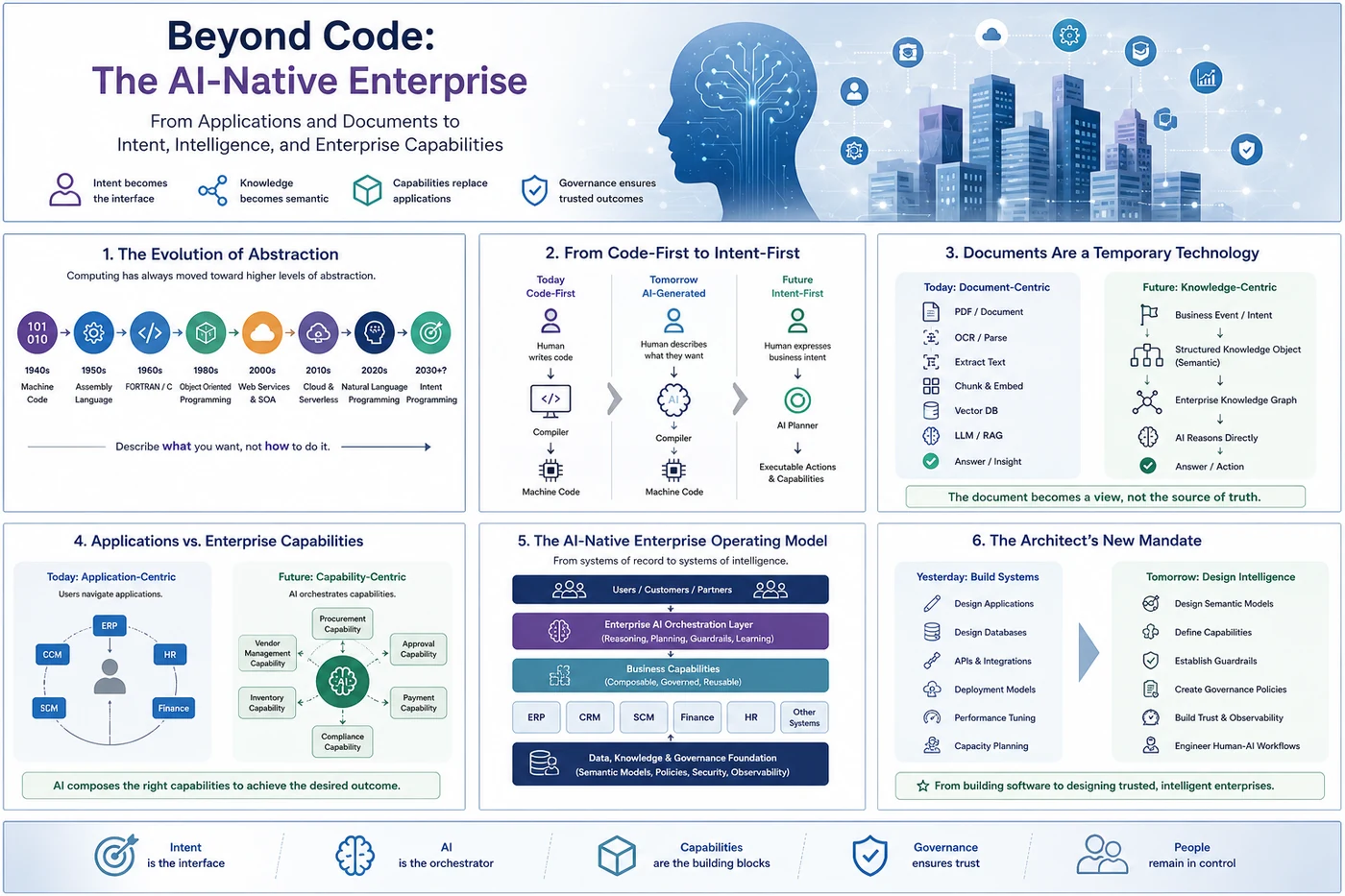
Why applications, documents, and programming may become implementation details.
“Every major advance in computing has raised the level of abstraction. Artificial Intelligence is not merely another abstraction — it changes what we mean by software itself.”
For nearly eight decades, enterprise computing has been built upon a remarkably consistent architectural model. Business requirements are translated into software, software manipulates structured data, and users interact with that software through applications specifically designed to support business processes. Whether implemented on mainframes, client-server platforms, or cloud-native architectures, the underlying paradigm has remained fundamentally unchanged: humans define the logic, software executes it, and applications provide the interface through which organizations operate.
Artificial Intelligence is frequently described as another capability to be integrated into this model. Organizations ask how to embed copilots into ERP systems, augment customer support with conversational agents, or enhance search using Retrieval-Augmented Generation (RAG). These initiatives are valuable, but they assume that the architecture itself remains intact.
I believe that assumption deserves to be challenged.
Artificial Intelligence is not simply another software component. It introduces a new computational model — one in which reasoning increasingly replaces explicit programming, business intent becomes the primary interface, and enterprise capabilities are orchestrated dynamically rather than hardcoded into applications.
This article explores that transition and considers what enterprise architecture may look like when intelligence, rather than software, becomes the organizing principle.
Computing has always been a story of abstraction
The history of computing can be understood as a continuous effort to move human attention away from implementation details and toward intent.
Early programmers manipulated binary instructions directly. Assembly language replaced machine code by introducing symbolic representations of processor instructions. High-level languages such as FORTRAN and C enabled developers to express algorithms without managing hardware directly. Object-oriented programming shifted focus from procedures to business objects. Cloud computing abstracted infrastructure, and serverless computing further abstracted deployment.
Each generation asked developers to describe what they wanted rather than how the machine should accomplish it. Artificial Intelligence continues this historical progression.
The difference is that previous abstractions still required humans to define algorithms. AI increasingly allows humans to specify outcomes while delegating the implementation itself to machine reasoning. That distinction is profound.
Code is becoming an intermediate representation
One question is often raised during discussions about AI-assisted software development: if AI already understands what needs to be accomplished, why does it generate code at all? Why not execute the task directly?
The question reveals an important misconception. Code exists because modern processors execute deterministic instructions. Whether those instructions are authored by humans or generated by AI is largely irrelevant to the processor itself. Every computational system ultimately reduces execution to deterministic machine operations.
What changes is not the existence of code, but its authorship. Historically, the software development lifecycle has followed a familiar sequence:
Business Requirement → Human Developer → Source Code → Compiler → Machine Code → Execution
Artificial Intelligence introduces a different sequence:
Business Intent → AI Reasoning → Generated Implementation → Execution
In this model, source code becomes an intermediate representation rather than the primary artifact. It remains necessary for deterministic execution, yet increasingly invisible to those requesting business outcomes. The relationship resembles the evolution from assembly language to modern programming languages. Assembly did not disappear; it simply ceased to be the language in which most developers think. Code may follow the same trajectory.
From programming systems to describing intent
If AI assumes responsibility for implementation, programming itself changes. Traditional software development asks developers to specify every decision explicitly. Control flow, validation rules, integrations, exception handling, persistence, and user interaction are all encoded directly within applications.
An AI-native architecture reverses this relationship. Instead of encoding behavior, organizations increasingly describe objectives. A request such as:
“Order replacement hydraulic pumps for every aircraft scheduled for maintenance next week while remaining within approved budgets, selecting preferred suppliers, complying with procurement policy, and notifying Finance after confirmation.”
contains remarkably little procedural information. Yet it contains abundant intent. The responsibility for transforming that intent into executable behavior shifts toward an orchestration layer capable of reasoning over enterprise policies, business capabilities, and organizational constraints.
Programming evolves from implementing behavior toward defining trust boundaries.
The application-centric enterprise
Enterprise architecture has traditionally organized itself around applications. CRM systems manage customer information; ERP systems manage finance and procurement; HR platforms manage personnel; supply-chain systems manage logistics. Applications became the primary organizational unit because they encapsulated business functionality behind dedicated interfaces.
This model has proven extraordinarily successful. However, it also reflects the limitations of software before AI. Business users rarely think in terms of applications — they think in terms of outcomes. Sales representatives do not wish to “navigate the CRM.” Finance departments do not aspire to “create purchase orders.” Operations teams do not wake each morning hoping to “open ERP.” Their objective is to accomplish business goals; applications are merely the mechanism.
Artificial Intelligence has the potential to dissolve this distinction.
Enterprise capabilities become the building blocks
If applications cease to be the primary interface, what replaces them? I believe the answer is enterprise capabilities. Rather than exposing hundreds of application screens, organizations expose reusable business capabilities:
- Customer Qualification
- Pricing
- Risk Assessment
- Procurement
- Payment Authorization
- Compliance Validation
- Inventory Allocation
- Shipment Scheduling
- Contract Review
These capabilities become composable building blocks. Artificial Intelligence determines which capabilities should participate in fulfilling a business objective, orchestrating them dynamically while respecting organizational policies. The architecture shifts from application composition to capability composition. Applications remain — their prominence diminishes.
Documents are an artifact of human communication
Perhaps the most controversial implication of AI-native architecture concerns documents. Modern enterprises produce enormous volumes of them — purchase orders, invoices, contracts, design specifications, incident reports, policies, meeting minutes. These artifacts exist primarily because humans communicate through documents. Machines do not require them.
Today's AI pipelines spend considerable effort extracting structured information from unstructured documents through OCR, parsing, chunking, embedding generation, and semantic retrieval. These technologies compensate for a deeper architectural problem: the enterprise stores knowledge in formats optimized for people rather than machines.
Imagine instead that enterprise knowledge is created natively as semantic business objects. A purchase order would no longer originate as a PDF. It would exist as a structured knowledge object containing supplier information, pricing, approval history, policy constraints, tax calculations, payment terms, logistics, audit metadata, and associated business events. A document could still be generated whenever human communication is required — but it would no longer be the source of truth. It would become one possible representation of the underlying knowledge. This inversion fundamentally changes enterprise information architecture.
Retrieval-Augmented Generation is an evolutionary step
Retrieval-Augmented Generation has become one of the defining architectural patterns of enterprise AI because it allows language models to ground responses in organizational knowledge. Its success should not be underestimated. Yet its existence reflects another transitional architecture.
RAG assumes enterprise knowledge already exists as fragmented documents distributed across repositories, and semantic retrieval compensates for that fragmentation. As enterprises increasingly adopt semantic business models, knowledge graphs, event streams, and structured capability models, retrieval itself becomes less dependent on textual similarity and more dependent upon semantic relationships. Artificial Intelligence evolves from retrieving documents toward reasoning over enterprise knowledge. The distinction is subtle but significant.
Deterministic software does not disappear
One misconception surrounding AI-native architectures is that deterministic software becomes obsolete. The opposite is more likely. As reasoning becomes probabilistic, governance becomes increasingly deterministic.
Artificial Intelligence may recommend approving a financial transaction. Deterministic systems must still verify authorization, segregation of duties, regulatory compliance, financial controls, policy enforcement, and audit requirements. Trust does not emerge from reasoning alone — it emerges from reasoning constrained by architecture. This principle will become one of the defining responsibilities of enterprise architects.
The enterprise operating system
Viewed from sufficient distance, today's enterprise architecture resembles a collection of applications connected through APIs and integration platforms. Tomorrow's architecture may instead resemble an operating system:
- Artificial Intelligence occupies the orchestration layer.
- Enterprise capabilities become reusable services.
- Knowledge becomes semantic rather than document-centric.
- Governance becomes embedded rather than external.
- Applications continue to exist, but increasingly as execution engines rather than destinations.
Users interact with business intent. Artificial Intelligence translates that intent into coordinated enterprise action.
A new role for enterprise architects
If this vision proves accurate, the responsibilities of enterprise architects change dramatically. Historically, architects designed systems. Increasingly, they will design decision environments. Their responsibilities expand beyond APIs, databases, and deployment models to include semantic models, reasoning boundaries, governance policies, trust frameworks, observability, and human oversight.
The architect's role shifts from designing software to designing trusted intelligence. That represents perhaps the most significant professional transformation since the emergence of distributed computing.
Conclusion: intelligence becomes the center of the enterprise
Every generation of computing has hidden another layer of implementation beneath a more expressive abstraction. Machine code became assembly. Assembly became high-level languages. Infrastructure became cloud services. Servers became functions. Artificial Intelligence continues that progression, but with a fundamental difference: for the first time, the abstraction is no longer a programming language. It is intent itself.
Applications, source code, documents, and even workflows are unlikely to disappear entirely. They will continue to exist because deterministic execution, regulatory compliance, and human communication remain essential. What changes is their role. They cease to be the primary interface through which organizations operate. Instead, they become implementation details beneath an enterprise whose organizing principle is intelligence.
The organizations that thrive in the coming decade will not simply adopt AI assistants or deploy conversational interfaces. They will redesign their architecture around semantic knowledge, composable business capabilities, deterministic governance, and reasoning systems capable of transforming business intent into trusted execution.
The AI-native enterprise is not defined by how much AI it uses. It is defined by where intelligence resides. When intelligence becomes the center of enterprise architecture rather than another component within it, we move beyond writing software. We begin designing systems that understand, reason, and act — while remaining worthy of the trust placed in them.